

Since Google launched AI Overviews in October 2024, visibility in search changed overnight. It’s no longer enough to rank; your brand must also appear inside the AI answers themselves. Answer Engine Optimisation (AEO) ensures that happens by structuring content for both humans and machines.
The New Reality: When Traditional SEO Isn’t Enough
If your website traffic has flattened even though your rankings look fine, you’re not alone. Many Australian businesses saw this after October 2024. Google’s new AI Overviews summarise information directly at the top of search results, often citing only a few trusted sources.
For users, it’s faster. For brands, it means your best content can vanish beneath the AI summary, that is, unless it’s optimised for retrieval.
At Springboard Digital, we’ve spent the past year tracking how AI Overviews evolve. Our findings show that traditional SEO remains essential, but the businesses winning visibility today are those also investing in AEO.
AEO vs SEO: What’s Changed and Why It Matters
| Focus Area | Traditional SEO | Answer Engine Optimisation (AEO) |
|---|---|---|
| Goal | Rank in organic listings | Be cited or surfaced inside AI Overviews |
| Format | Page-level relevance | Passage-level, structured answers |
| Markup | Optional schema | Essential schema (FAQ, HowTo, Article) |
| Metrics | Click-throughs, impressions | Mentions, citations, visibility |
| Voice Search | Secondary | Core discovery channel |
| Success Signal | Position #1 | Inclusion within AI Overview |
SEO helps you get found; AEO helps you get featured.
Case Study: How a Client Gained AI Overview Visibility
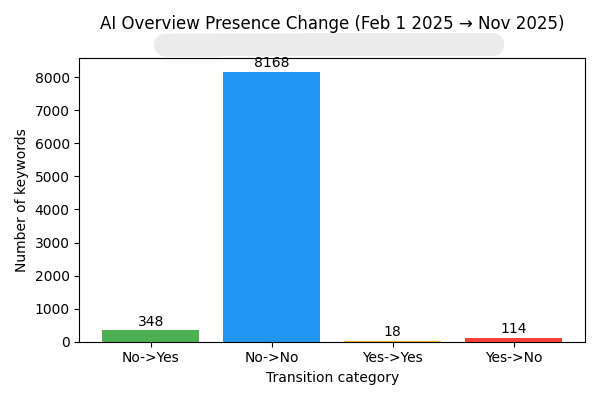
Using Ahrefs data from February 2025 to November 2025, we analysed how one client’s keywords transitioned as our AEO strategy began to work its magic and the feature matured. Across 8,648 keywords, the number showing an AI Overview jumped from 132 to 366, a net gain of +234.
| Transition (Feb → Nov) | # of Keywords | What It Means |
|---|---|---|
| No AI Overview → AI Overview | 348 | New queries gaining visibility |
| No AI Overview → No AI Overview | 8 168 | Queries still excluded |
| AI Overview → AI Overview | 18 | Retained inclusion |
| AI Overview → No AI Overview | 114 | Lost visibility, often low-ranking or outdated pages |
The Challenge
Before October 2024, the company ranked well but lacked structured data and scannable content that AI systems could parse. Their articles answered questions, but not in the concise, schema-friendly way AI Overviews prefer.
The Approach
From November 2024 to April 2025, our SEO team applied a strategy that included:
- Implementing FAQ and Product schema across key pages
- Adding 2–3 sentence summaries and Q&A blocks to lead each section
- Introduced comparison tables and step-by-step content
- Strengthening internal linking and entity definitions for clearer context
The Results
By November 2025, AI Overview visibility had more than doubled as a result of our content updates:
- A major category keyword rose from #90 to #1 and gained AI Overview citation
- A “best product” query jumped from #64 to #1 after Review schema and customer Q&A updates
- Another high-volume term moved from #33 to #1 and was featured in the panel
Keywords that gained AI Overview inclusion mostly sat within the top 10 organic results; those that lost averaged position 31, showing that: ranking strength + structure = visibility.
The Outcome
Within 9 months, this business gained 230 + new AI citations and a measurable uptick in branded search queries. The message is clear: clarity, schema and authorship drive AI visibility, not luck.
By regularly auditing your keyword set and aligning your content strategy with emerging SERP features, you can position your brand to appear in Google’s AI Overviews, driving greater visibility and authority in AI‑driven search.
Explore more of our Case Studies.
Why AI Overviews Matter to Your Business
AI Overviews are layered on top of SEO and are not a replacement for it. They shape how consumers perceive brands before they even click.
For decision-makers, that visibility translates into:
- Authority: appearing in AI summaries signals industry trust
- Brand recall: users remember brands that “answer first”
- Conversion lift: increased branded search and referral traffic
Three key implications for marketers:
- Personalisation rules: AI Overviews adapt by intent and location
- Passage relevance counts: Google extracts concise, structured snippets
- EEAT is non-negotiable: authorship and first-hand expertise drive trust
How to Optimise for AI Search Engines
1. Start with User Intent
Identify whether queries are informational (“what is”), comparative (“best”), or transactional (“how to choose”).
Write a 2–3 sentence answer first, then expand with proof and examples.
Example: “Which energy drinks are most popular in Australia?” followed by a summary and supporting table.
2. Use Schema Everywhere
Apply FAQ, HowTo, Product, and Article schema so Google can understand context and relationships.
3. Publish Scannable Passages
Structure content with clear H2/H3 headings, bullet points, and concise definitions. AI retrieval relies on these “passages” to assemble answers.
4. Show Your Experience
Include author bylines, testimonials, and case insights. Google’s EEAT update (Experience, Expertise, Authoritativeness, Trustworthiness) favours authentic voices.
5. Audit and Measure
Track AI Overview presence using Ahrefs or SERP APIs. Prioritise updates for pages that rank well but aren’t cited.
Tip: Focus on brand mentions and AI citations, not just keyword positions.

Beyond SEO: The Mindset Shift
AEO is about making your brand intelligible to both people and machines.
That means defining your entities (services, locations, products), logically linking them, and writing content that reads like answers rather than advertising.
Springboard Digital’s approach builds this into every SEO content strategy so clients are retrieval-ready across AI, voice, and search.
Key Takeaways for Business Leaders
- SEO and AEO work together to build sustained visibility.
- Schema markup is mandatory for AI interpretation.
- EEAT is a ranking signal for AI citations.
- Regular auditing keeps you aligned with SERP features.
- Partnering strategically ensures you stay ahead of algorithmic shifts.
Why Springboard Digital
We help Australian brands transition from traditional SEO to AI-era visibility. Our methodology combines:
- Evidence-based insight: We analyse thousands of queries to track changes in SERP features.
- Technical precision: Crawlability and schema validation as standard.
- Human-led content: Every piece is authored for expertise and credibility.
- AI retrieval focus: Optimised for AI Overviews, voice search, and RAG.
Looking ahead to 2026, AI Overviews will continue to evolve. They’ll blend real-time insights, visual elements, and verified authorship into search results. Now is the best time to future-proof your content for the next generation of intelligent discovery.
Let’s explore how your brand could appear in AI search before your competitors do.
Contact Us Today
FAQs
AEO (Answer Engine Optimisation) structures your content so AI search engines can retrieve and cite it within generated answers.
SEO gets you ranking; AEO gets you referenced within AI and voice search results.
Most clients see AI Overview citations within 3–6 months of structured content and schema updates.
Some clicks may drop, but brands featured gain credibility, brand searches, and conversion trust.
Yes. AI Overviews can merge with map and entity data, so keep your Google Business Profile up to date.